
P0420: Catalyst System Efficiency Below Threshold (Bank 1)
P0420 means the bank 1 catalytic converter is not cleaning exhaust gases efficiently. Check upstream causes and leaks before replacing it.
A general guide for any vehicle that sets P0420. Part locations and procedures vary by make and model, so check your vehicle's service manual for yours.
What P0420 means
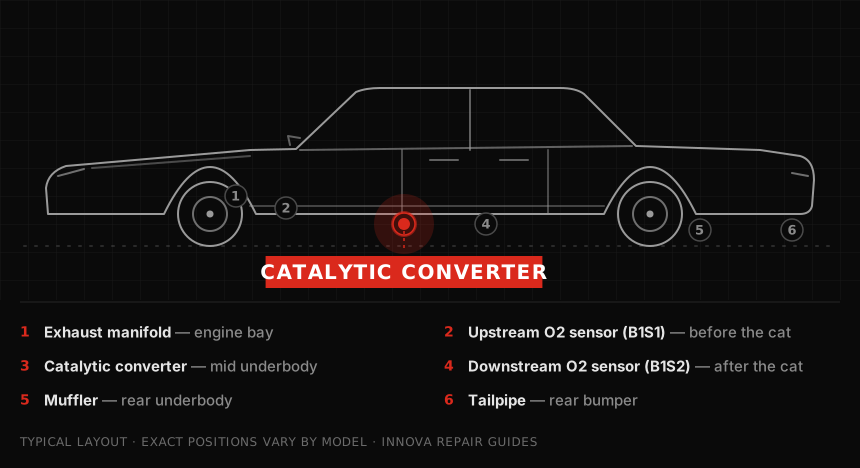
P0420 is Catalyst System Efficiency Below Threshold (Bank 1). The downstream oxygen sensor shows the catalytic converter on bank 1 is not cleaning exhaust gases as efficiently as required.
This is usually not a drivability emergency, but it will fail emissions testing and can hide an upstream problem. The code could point to a failing converter, an exhaust leak, a lazy oxygen sensor, or an upstream air/fuel problem feeding bad gas to the cat.
Drive with caution. There is no immediate drivability or crash risk, and the engine should run normally with no power loss expected. Do not attempt emissions testing until the car is repaired, and avoid extended highway driving. Keep to short trips until the problem is diagnosed. Severity is moderate. Plan to fix the fault within 7 to 30 days. A prolonged rich or lean condition can damage the converter further.
Common causes of P0420
- Aging or failing catalytic converter
- Upstream air/fuel imbalance (lean or rich) damaging the cat over time
- Exhaust leak before the downstream sensor
- Lazy or biased downstream O2 sensor
Work safely
- Unless a step says otherwise, work with the engine off and cool, the parking brake on, and the vehicle on level ground.
- Keep sparks, flames and cigarettes away when you work near fuel or EVAP parts, and work in a well-ventilated place.
- Wear safety glasses and gloves.
- This guide doesn't replace your vehicle's service manual. If a step is beyond your tools or experience, have a shop do it.
How to fix it, step by step
Reseat the downstream oxygen sensor connector
- Disconnect and reseat the downstream O2 sensor connector (bank 1, after the converter).
- Tip: Corrosion or a loose connection can cause a false P0420.
Add a fuel system cleaner
- Pour a fuel system cleaner additive into the fuel tank to remove carbon deposits that may be causing a rich condition and damaging the converter.
Clear the code and drive the vehicle
- Clear the code with a scanner, then drive a normal drive cycle: mixed city and highway driving for 10 to 15 minutes.
- Tip: If the code returns immediately, the converter or sensor is likely faulty.
Inspect the exhaust system
- Look over the exhaust system for cracks, rust holes, or loose heat shields between the engine and the converter.
- Tip: An exhaust leak before the downstream sensor can trigger P0420 without a bad converter, and leaks are cheaper to fix than a converter.
Scan for other codes
- Check for any other stored or pending codes, such as misfire, lean/rich, or O2 sensor codes, using a full scan. If found, those must be fixed first.
- Tip: Upstream problems like a vacuum leak or bad fuel injector can damage a good converter. Fixing them first avoids unnecessary converter replacement.
Listen for rattling in the converter
- Listen for rattling inside the converter, especially when accelerating gently.
- Tip: A rattling sound suggests internal catalyst breakdown and the converter will almost certainly need replacement. A quiet converter may just need sensor diagnosis.
Diagnose catalyst efficiency and upstream air/fuel balance
- Check catalyst operation with a scope or live data stream before replacing parts.
- Verify downstream O2 sensor response.
- Diagnose and fix any accompanying lean/rich or misfire codes first.
- Warning: P0420 alone does not tell you whether the converter is failing or an upstream problem, such as a lean/rich condition, misfire or exhaust leak, is damaging it. Difficulty: moderate.
Repair exhaust leaks before the converter
- Check for exhaust leaks near the converter.
- Check manifold gaskets, flex pipe, and welds for cracks or loose clamps.
- Tip: A leak upstream of the downstream O2 sensor can trigger P0420 without converter failure. Difficulty: easy.
Replace the catalytic converter if diagnosis confirms failure
- Replace the catalytic converter only after the root cause is fixed and upstream causes are ruled out, including air/fuel imbalance, misfire and exhaust leaks.
- After the repair, use Drive mode to complete the emissions monitor cycle.
- Warning: Replacing a good converter will not fix P0420 if the root cause remains. Difficulty: hard.
Parts you may need
- Exhaust manifold gasket
- Catalytic converter bank 1
Tools
- Scanner
- Scope or live data stream
Common questions
Is it safe to drive with a P0420 code?
How soon should P0420 be fixed?
What usually causes P0420?
Will a car with P0420 pass an emissions test?
The bottom line
P0420 means the bank 1 catalytic converter is not cleaning exhaust gases efficiently enough. The code alone does not say whether the converter is failing or an upstream fault is damaging it, so diagnose with a scope or live data before replacing parts. Replace the catalytic converter only after the root cause is fixed.
Based on AskFixy, Innova's repair assistant, and reviewed by Innova Electronics before publishing.